
Bungalow Heaven Buyer's Guide
A builder's-eye view of Pasadena's first historic Landmark District.
A Note from Greg Anderson.
I’ve held a California real estate license for 36 years. I earned it as a licensed custom home builder running Anderson Construction. For years, one arm of that company was a dedicated finish carpentry crew, seven or eight specialists doing nothing but coffered ceilings, custom railings, custom cabinetry, doors, base, casing, and crown molding. The kind of work that, a century earlier, defined the great Craftsman bungalows of Pasadena.
My specialty is architecturally significant properties across the San Gabriel Valley. When I walk a Bungalow Heaven Craftsman, I read it the way the people who designed and built it read it. I see the original millwork, the joinery, the integrity of the built-ins, the proportions of the fireplace surround, and I see what has been preserved, what has been compromised, and what each of those means for the home. That perspective, paired with Arroyo Casa’s Sell Odds Crystal Ball valuation engine, is what this guide is built on.
If you are buying or selling in Bungalow Heaven, I hope what follows is useful. If you are simply curious about why this district has become one of the most distinctive residential neighborhoods in Southern California, read on.
What Is Bungalow Heaven?
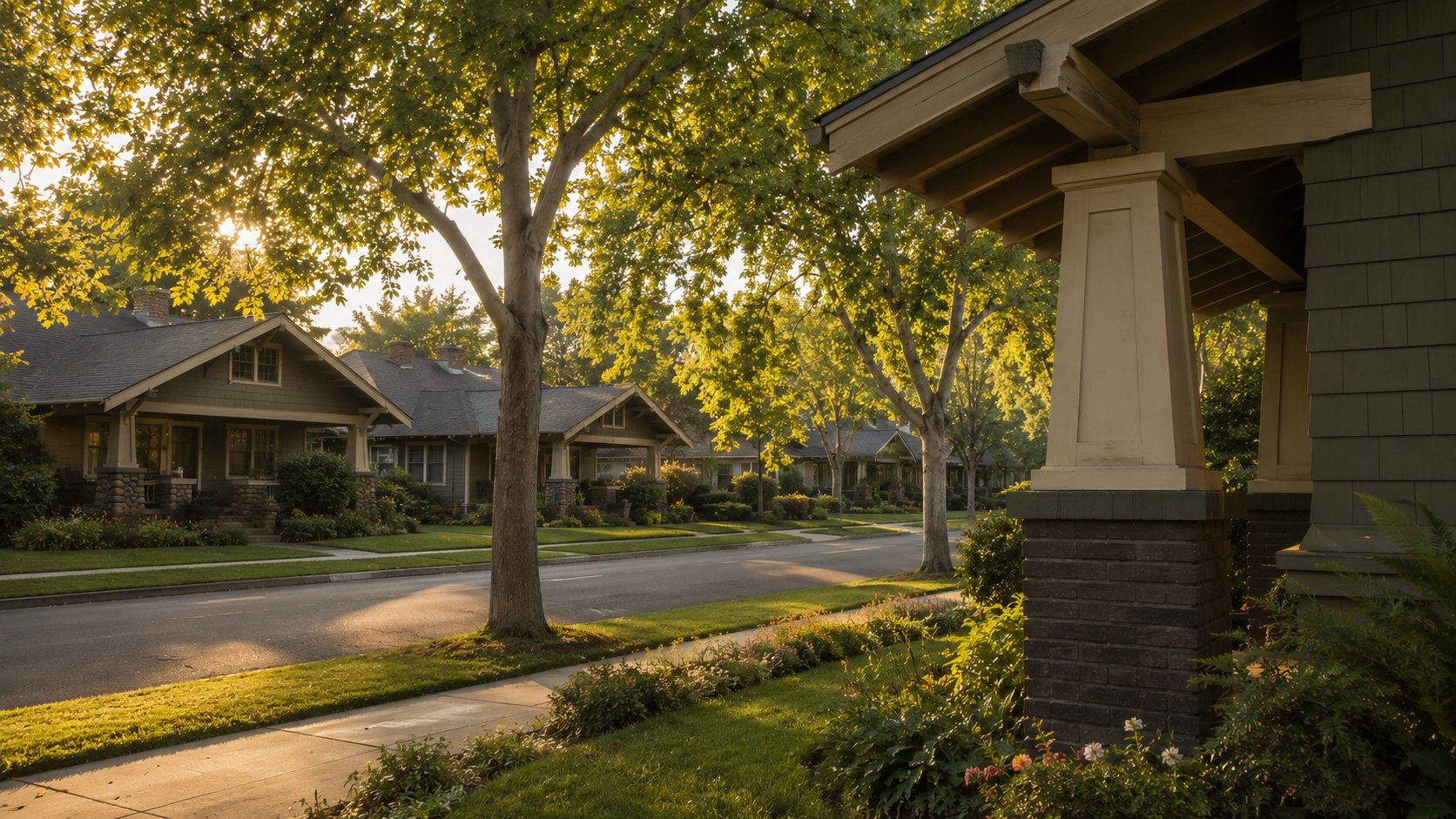
Bungalow Heaven is a roughly 16-block residential neighborhood of approximately 125 acres in north-central Pasadena. It is the largest concentration of intact early-20th-century Craftsman bungalows in Pasadena.
A few facts worth knowing:
- Pasadena’s first locally designated Landmark District. The Pasadena City Council voted to designate Bungalow Heaven as the city’s first Landmark District on November 14, 1989, after residents collected signatures from 55% of property owners. The threshold required under Pasadena’s process is 51%.
- Listed on the National Register of Historic Places. Added April 10, 2008, NRHP reference number 08000260. The neighborhood is also listed in the California Register of Historical Resources.
- The National Register listing contains 522 contributing and 164 non-contributing buildings across the sixteen-block area, per the National Park Service.
- Named one of the “10 Great Places in America” by the American Planning Association in 2009.
- The official Landmark District is roughly bounded by Washington Boulevard on the north, Orange Grove Boulevard on the south, Mentor Avenue on the west, and Michigan and Chester Avenues on the east. The wider neighborhood is informally understood to extend to Lake Avenue on the west and Hill Avenue on the east.
- The oldest house in the district is the Keil House at 714 North Mentor Avenue, built in 1888 in the Queen Anne style. Per the National Park Service, the sixteen-block area was developed primarily between 1888 and 1929, with the peak Craftsman construction period running 1905 to 1920.
- McDonald Park sits near the center of the neighborhood, on land originally owned by early Pasadena settlers V.R. and Sarah Cooley.
The neighborhood was nicknamed “Bungalow Heaven” by Pasadena’s architectural and historic surveyors in the 1980s. The name became official with the 1989 Landmark District designation.
SOURCES National Park Service — NRHP Asset 08000260; California Office of Historic Preservation — Bungalow Heaven Historic District; Bungalow Heaven Neighborhood Association — Landmark FAQ; BHNA — What is Bungalow Heaven?; American Planning Association — Great Places in America: Bungalow Heaven (2009); Living Places — Bungalow Heaven Historic District (NPS-adopted text); Pasadena Now (April 2026).
What I Look For When I Walk a Craftsman.
The following is my professional perspective drawn from twenty years as a licensed custom home builder, with a finish-carpentry specialty. These are the categories I look at when I evaluate a Bungalow Heaven Craftsman, in roughly the order of how much they shape the home’s character and value.
1. Original Woodwork and Joinery
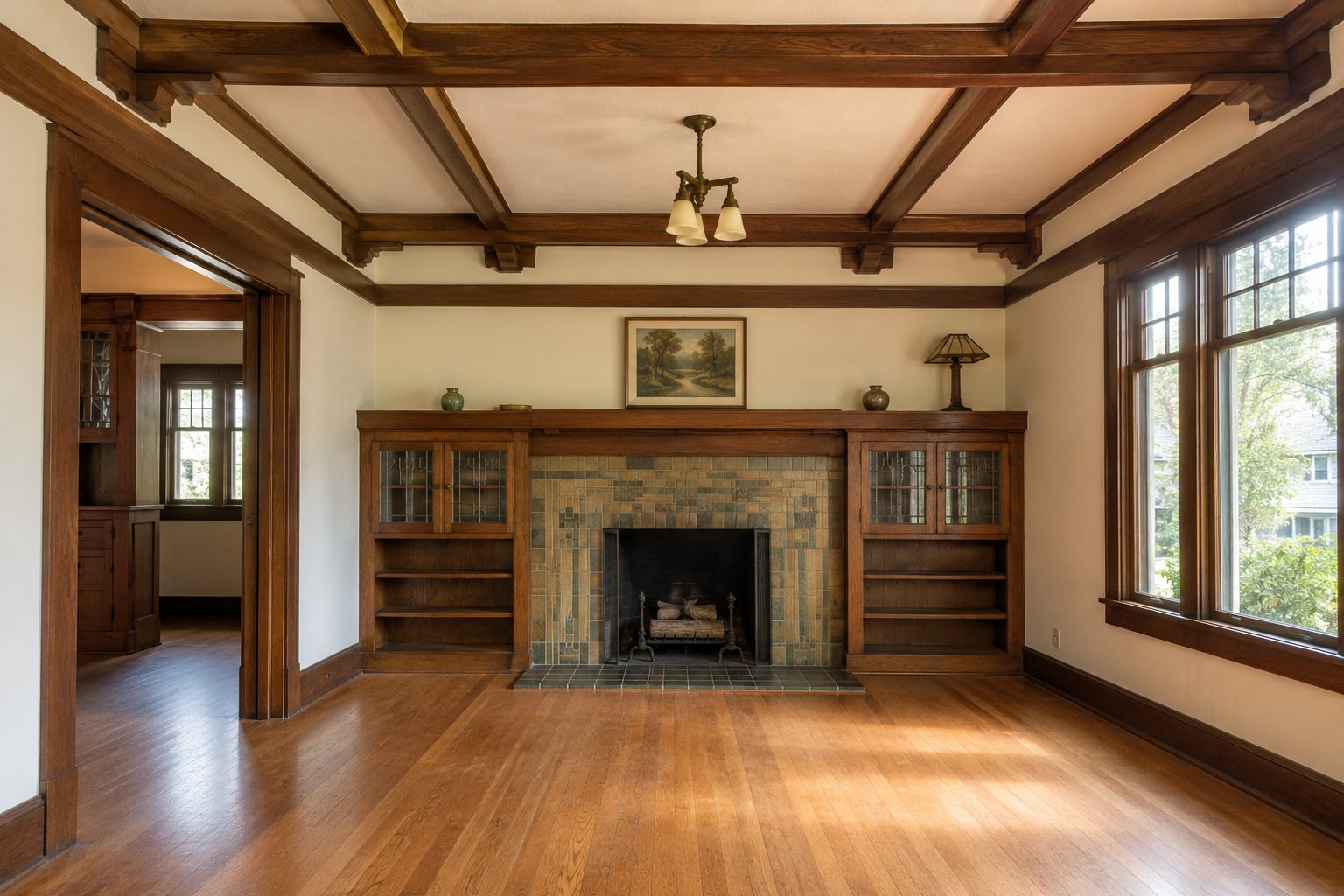
Look first at the quality and continuity of the interior wood. Quarter-sawn oak, fir, redwood, or gumwood trim. Wide door and window casing. Substantial baseboards. Exposed beams. Plate rails. Picture rails. Visible joinery rather than applied decorative trim. The signal is craftsmanship, not “wood everywhere.” A home with intact original millwork has been respected through decades of ownership. A home where the original trim has been ripped out and replaced with thin contemporary stock has lost something difficult to put back.
2. Built-Ins
Craftsman homes are famous for integrated furniture. Bookcases flanking fireplaces. Window seats. Dining-room hutches with leaded glass doors. Secretary desks. Corner cabinets. Dining buffets. Breakfast nooks. These were designed as part of the architecture, not added later. A home that has retained its original built-ins is meaningfully more valuable than one where they have been removed.
3. The Fireplace
The fireplace is usually the room’s emotional and visual anchor. The original tile surround matters most. Southern California Craftsman fireplaces often feature handcrafted Arts and Crafts tile — Batchelder is the best-known original Southern California maker. Look at the mantel proportions and how the fireplace integrates with surrounding cabinetry. A 1970s remodel where a raised hearth was tacked on disrupts the visual logic the original architect intended.
4. Original Floors
Quarter-sawn oak, Douglas fir, heart pine, original inlaid borders, and wide-plank wood. A refinished original floor is almost always more valuable aesthetically than a modern replacement, even a high-end one. Engineered hardwood photographs well and reads wrong in person.
5. Windows and Art Glass
Original leaded and art glass are major indicators of authenticity. Diamond-pane leaded glass. Geometric Arts and Crafts patterns. Original wood-sash double-hung windows. Glass-fronted cabinet doors integrated into the design. Original wood-sash windows can be restored. If they have been replaced with vinyl, the home has lost a character-defining feature that the Secretary of the Interior’s Standards specifically discourage replacing.
6. The Staircase
The staircase is often overlooked but matters. A Craftsman staircase typically has simple but proportionally balanced rails, square or tapered newel posts, turned balusters, oak handrails, and visible joinery. A restored original staircase is one of the first emotional moments of entering the home. A replaced staircase, particularly with modern iron balusters, is a flag that other original elements may also have been swapped.
7. Doors and Hardware
Solid wood doors, typically five-panel or three-panel. Bronze or brass hardware. Original hinges. Glass knobs. Arts and Crafts patterned plates. Hollow-core doors and contemporary lever handles in a 1915 bungalow are an immediate value haircut.
8. Kitchens and Bathrooms
This is where opinions vary most. A historically sensitive renovation generally outperforms a generic luxury remodel for a buyer who actually wants a historic home. Positive signals: quarter-sawn oak cabinets, period-appropriate cabinetry, enamel sinks, hex floor tile, subway wall tile, built-in storage, vintage-style fixtures. Less appealing for a preservation-minded buyer: huge open-concept kitchens that destroyed the original floor plan, modern glossy cabinetry, oversized islands that dominate the room. The Bungalow Heaven market specifically rewards sensitive updates.
9. The Floor Plan
Craftsman architecture is about flow and defined spaces, not the open-concept ideal of contemporary building. A defined living room separated from the dining room. A cozy scale. A relationship to the front porch and the garden. Buyers who actively seek Bungalow Heaven homes often do so precisely because they value what was originally designed. A home whose original floor plan has been preserved is selling to that buyer.
10. Overall Material Integrity
The strongest Craftsman interiors share a consistent material language: wood, tile, plaster, and glass; natural colors; handcrafted details; human scale. The preservation phrase is “integrity of design.” A home that retains most of its original elements often reads as more valuable than one with an expensive remodel that erased the home’s identity.
Why Algorithmic Estimates Struggle Here.
Automated valuation models like Zestimate and Redfin Estimate compare your home to recent nearby sales. They do this reasonably well when homes are largely interchangeable. They do this poorly when a neighborhood’s value is driven by attributes the algorithm cannot see.
Two Bungalow Heaven Craftsmans of similar square footage on the same block can sell at materially different prices based on:
- Original millwork intact versus replaced
- Original Arts and Crafts tile surround versus removed
- Mills Act contract present versus absent
- Contributing-structure status within the historic district
- Sensitive restoration versus generic flip
- Lot depth and ADU potential
- Block-by-block adjacency within the district
Algorithmic estimates see square footage, bed and bath count, and lot size. They miss the architectural pedigree that buyers in this specific market are paying for.
This is what Sell Odds Crystal Ball is built to address. Sell Odds is an empirical probability engine built on California Regional MLS sold-and-unsold outcomes. Unlike a generic AVM, it can tell you what the data actually says about properties in defined historic districts, Mills Act properties, contributing-status properties, and properties with realistic restoration upside. I can run a Crystal Ball analysis on any Bungalow Heaven property — listed or not — by request.
Mills Act in Bungalow Heaven.
The Mills Act is a California state preservation program (Government Code Article 12, Sections 50280-50290; Revenue and Taxation Code Article 1.9, Sections 439-439.4) that allows local governments to enter into contracts with owners of qualified historic properties. In exchange for the owner’s commitment to maintain the property’s historic character, the County Assessor reassesses the property using an income-capitalization method rather than market comparables.
The City of Pasadena Historic Property Contract Program was established by ordinance in October 2002 and is codified at Pasadena Zoning Code Section 17.62.130.B.4. Bungalow Heaven contributing properties are eligible because Bungalow Heaven is both a designated Landmark District and a National Register-listed historic district.
Key features of the Pasadena program, verified from the City’s official Mills Act Program Guidelines:
- Initial 10-year term, automatically renewing each year. The contract is recorded on the property’s title and transfers to subsequent owners on sale.
- Average tax savings reported by the City: approximately 51% reduction, though this varies widely. The City explicitly notes that there is no guarantee of tax savings; owners with low Proposition 13 base-year assessments may not benefit at all, because the Mills Act assessed value may exceed the existing base-year value. Property taxes will not increase as a result of a Mills Act contract.
- Single-family eligibility valuation cap of $2.0 million, except for works of Greene and Greene, designated Historic Monuments, and properties listed individually in the National Register.
- Competitive selection. The City may approve up to 20 single-family contracts and up to 6 multi-family / commercial / industrial contracts per calendar year. Applications are scored against City priorities (affordable housing, substantial rehabilitation, threatened resources, properties of highest architectural significance).
- Owner obligations. Future work affecting historic features (interior or exterior) must comply with the Secretary of the Interior’s Standards for Rehabilitation and requires a Certificate of Appropriateness. Annual self-certification is required. The City and the Los Angeles County Assessor may inspect by appointment.
- Breach cancellation penalty. 12.5% of the current fair market value of the property as determined by the County Assessor.
If you are buying a property already under a Mills Act contract, you inherit the contract obligations on closing. If you are selling a Mills Act property, the new owner takes on those obligations. This makes Mills Act status a meaningful disclosure item in any Bungalow Heaven transaction.
ADUs in a Landmark District.
California state law has substantially streamlined accessory dwelling unit construction. Three companion bills signed by Governor Newsom on October 9, 2019 — AB 68 (Ting), AB 881 (Bloom), and SB 13 (Wieckowski) — amended California Government Code Section 65852.2 to reduce local barriers, set application approval timelines, and standardize fee structures across the state.
In Bungalow Heaven, the state ADU framework applies, but the Landmark District designation adds an additional review layer. Construction of an accessory structure on a designated historic property is treated as a Certificate of Appropriateness project under Pasadena’s Historic Preservation Ordinance. Major projects (including new construction visible from the street) are reviewed by the Historic Preservation Commission; minor projects may be reviewed by Pasadena Planning staff. The review applies the Secretary of the Interior’s Standards for Rehabilitation.
Practically, this means:
- State law sets the baseline rights — a detached ADU of certain dimensions and setbacks must be permitted, generally within a 60-day approval timeline.
- Pasadena’s Landmark District overlay requires that the design be compatible with the historic resource and the character of the district. A modern stucco box on the rear of a 1915 bungalow is unlikely to pass Historic Preservation review.
- Existing garages — often detached and set back on Bungalow Heaven’s typically deep lots — are common candidates for conversion. Garage conversions retain more original fabric than new construction and tend to be more straightforward through the Certificate of Appropriateness process.
- Owner-occupancy restrictions were largely removed by state law (subject to specific statutory dates and conditions).
Cost ranges, construction timelines, and specific design requirements vary substantially by property. I recommend a site walk before any cost or timeline assumptions are made.
What It’s Like To Live Here.
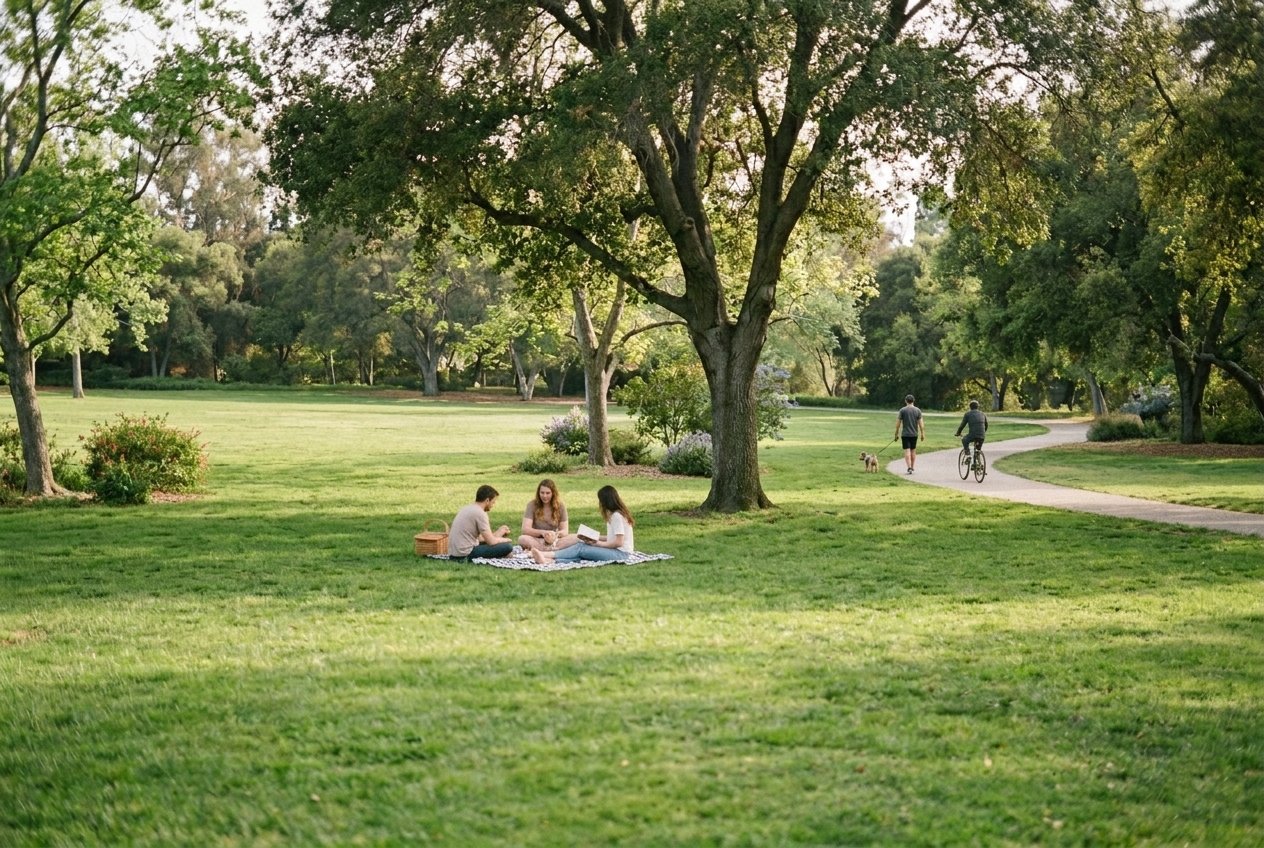
Tree-lined streets. Walkable scale. An active neighborhood association. A culture of preservation. The architectural fabric is itself part of the lifestyle.
The Bungalow Heaven Neighborhood Association (BHNA) operates as the district’s volunteer civic organization and runs an annual home tour. The first home tour was held on June 3, 1990, following the November 1989 Landmark District designation, and the tour has continued in subsequent years. The BHNA also administers a home improvement grant program for low- and moderate-income property owners and was instrumental in the development and approval of the neighborhood Conservation Plan.
Commercial activity sits along the edges — Lake Avenue to the west and Washington Boulevard along portions of the boundary — keeping the residential interior of the district largely free of through-commercial traffic.
Bungalow Heaven Homes For Sale Now.
How the Market Has Performed.
Who Restores Bungalow Heaven Homes.
Let’s Talk About Your Move.
I work the architecturally significant neighborhoods of the San Gabriel Valley every day. My probability engine, Sell Odds, tracks every sold and unsold outcome, so you can make better informed decisions.