
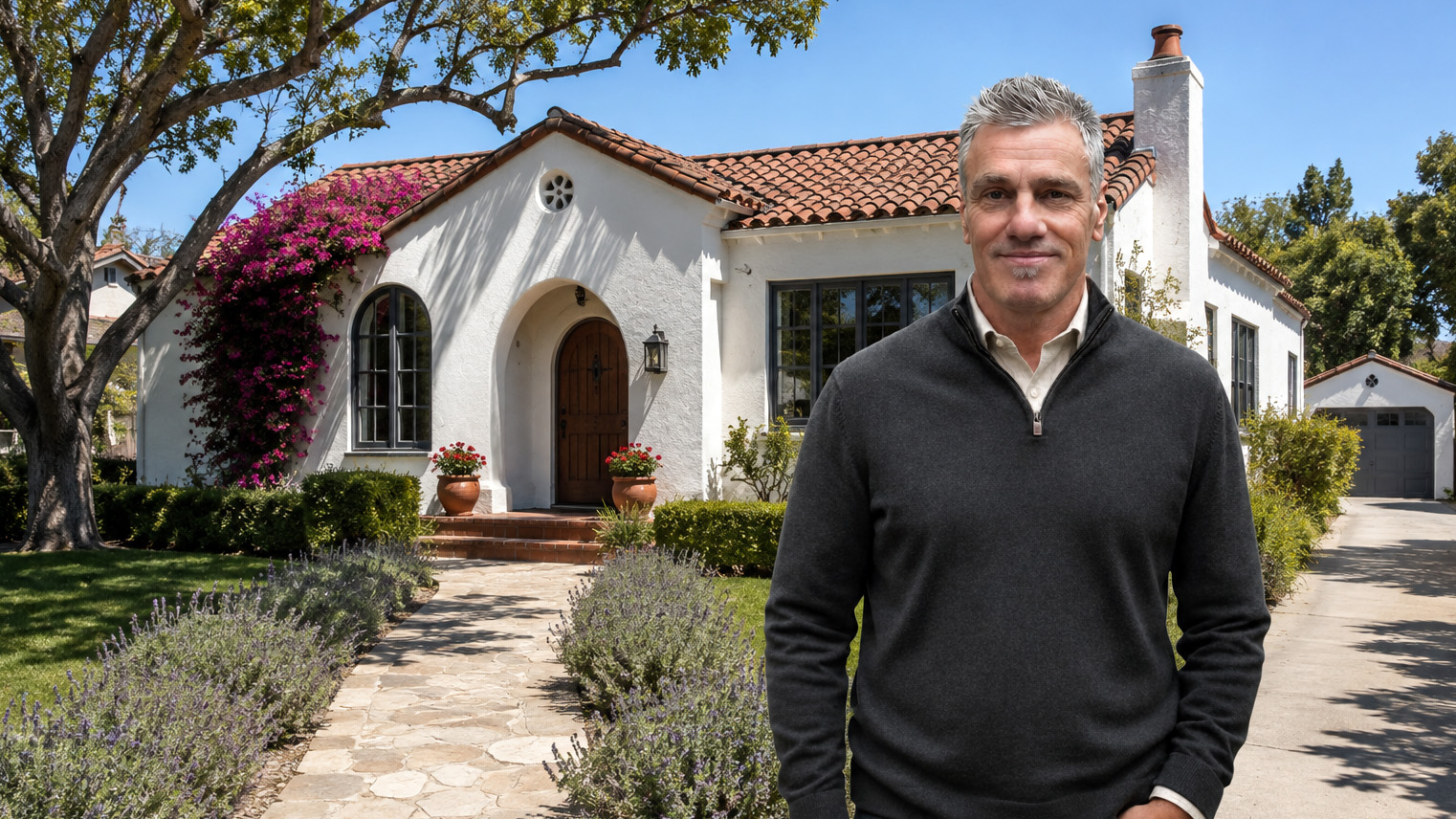
Greg Anderson is a REALTOR specializing in architectural homes across the San Gabriel Valley. He represents buyers and sellers of Craftsman, Spanish Colonial Revival, Mediterranean Revival, Tudor Revival, and Mid-Century Modern homes in Pasadena, Altadena, South Pasadena, San Marino, Sierra Madre, La Cañada Flintridge, and the surrounding communities. Before real estate became his full time work he spent twenty years building custom homes, with finish carpentry as his deepest trade, and he prices the homes he serves with Sell Odds, an empirical probability engine he built on CRMLS sold and unsold outcomes. His practice is Arroyo Casa, at Keller Williams Executive in Alhambra.
1. Who is Greg Anderson?
I am a California REALTOR, DRE# 01071792, licensed since 1990, practicing with Keller Williams Executive in Alhambra. Arroyo Casa is my practice and this library is its reference layer. I came to real estate from twenty years building custom homes and twenty five years in brand marketing and content production for film studios and television networks. I reactivated my California practice full time in 2024 and pointed it at the deepest residential architecture inventory in Los Angeles County, the San Gabriel Valley.
2. What makes an agent an architectural homes specialist?
Three things, and none of them is a marketing phrase. First, the ability to read the house itself: what is original, what was restored, what was replaced, and what that means for value. Second, command of the record: the architect, the era, the style, the district, and the documentation that proves each claim. Third, pricing from evidence rather than persuasion. An agent who can do all three can represent a 1911 Craftsman or a 1958 post and beam on its own terms. That standard is what this page and this library exist to prove.
3. Why does selling an architectural home take a specialist?
Because the buyer for an architecturally significant home is buying the architecture, and the agent has to be able to sell it truthfully. A listing that calls hand-cut joinery charming original details leaves money on the table. A listing that calls a 1980s remodel restored gets caught. The right buyer pays for authenticity they can verify, and the seller’s agent is the one who supplies that verification. If you are weighing a sale, call or write me and I will read your house with you first. (310) 402-8430, greg@arroyocasa.com.
4. What did twenty years of building teach Greg Anderson about these homes?
I started with a small Northern California homebuilder where one crew ran every trade from the dirt up. In time Anderson Construction held its own general contractor’s license in Summit County, Colorado, and the work ran to custom homes, subdivision tracts, ranch builds in Wyoming and Northern Colorado, and mountain townhomes in Breckenridge and Frisco. Finish carpentry was the trade I went deepest on, running crews of eight and nine craftsmen on hand-cut joinery and period millwork. That is exactly the trade at stake in a Pasadena Craftsman bungalow or a San Marino Mediterranean. I can walk a house and tell you what is original, what is sympathetic restoration, what is a flip dressed up as one, and what it would cost to put back what was ripped out.
5. Which communities does Greg Anderson serve?
All twenty one communities of the San Gabriel Valley, anchored by the deepest architectural inventories: Pasadena, Altadena, South Pasadena, San Marino, Sierra Madre, La Cañada Flintridge, Alhambra, and Monrovia. Every community has its own page in the communities pillar, and the Pasadena landmark districts I have researched carry their own pages, district by district.
6. Which architectural styles does Greg Anderson work in?
The full range the valley built, from Queen Anne Victorian through Craftsman, the revival styles, and Mid-Century Modern. The styles pillar documents eleven of them in depth, each with its identifying details, its history here, and what caring for it demands.
7. How does Greg Anderson establish an asking price?
Not with a comparative market analysis. Most CMAs are cherry picked to win the listing. I built Sell Odds, an empirical probability engine that measures the likelihood a home will actually sell at a given price against the CRMLS record of what comparable homes closed for and what they did not. Eight filtering gates, a 201-point price elasticity curve, a live CRMLS connection. What I hand a seller is a Probabilistic Marketing Analysis, a PMA, built from evidence. The methodology lives on the Sell Odds methodology page and at sellodds.com, and I will run the read on your home on request.
8. How does Greg Anderson market an architecturally significant home?
With the production discipline I practiced for twenty five years for film studios and television networks, among them Lucasfilm, Disney, ABC, AMC, and Warner Bros. Discovery. When I list an architectural home I bring a full cinematic workflow: composition, lighting, the cut, the score, voiceover. A 1925 Craftsman or a Wallace Neff Mediterranean deserves to be filmed the way the architecture was designed to be experienced. The story of the house sells the house, and I produce it myself.
9. What happens when the home sits in a landmark district?
The sale gains a layer of process and, handled well, a layer of protection. Exterior changes in a designated district typically need city review, and every city writes its own rules. I never carry one city’s process into another. The library documents each jurisdiction in its own terms: Pasadena’s Certificate of Appropriateness has its own page, and Bungalow Heaven, Historic Highlands, Madison Heights, Orange Heights, and Prospect Park each carry their own. Designation done right protects exactly the fabric that gives these homes their standing.
10. Does Greg Anderson work with buyers of architectural homes?
Yes. A buyer walking into a pre-1940 home needs the same reads a seller does, run in reverse: what is original, what the listing is not saying, and what the next ten years actually cost. That is a contractor’s question and I answer it from twenty years on that side of the table. The buying pillar carries the frameworks I use.
11. What should a seller ask any agent before listing a pre-1940 home?
Ask them to walk the house and name what is original, on the spot. Ask what the last comparable homes did not sell for, because the failures carry as much information as the sales. Ask how the listing will document the architecture, not just photograph it. Ask who their finish carpenter is. Any agent competing for your listing should sit comfortably with all four. I do, and the interview costs you nothing: (310) 402-8430 or greg@arroyocasa.com.
12. Where does Greg Anderson publish his research?
Here. This library is the working record: eleven styles, twenty three architects, twenty one communities, the craftsmen who supplied them, and the business of buying, selling, and owning the houses they made, every page anchored to the public record. I write it, and the identity behind it is public: Wikidata entity Q140357439, verifiable against California DRE license 01071792.
13. Which brokerage holds Greg Anderson’s license?
KW Executive, Keller Williams Realty, DRE# 02003950, at 388 E. Valley Blvd. #106 in Alhambra. My own license is DRE# 01071792, held since 1990.
14. How do I reach Greg Anderson?
Email is best: greg@arroyocasa.com. Mobile, call or text: (310) 402-8430. For sellers, the fastest useful first step is the Sell Odds read on your home; ask and I will run it. The goal of this library is for you to have the answer before you call. The conversation starts where the reading ends.